

Tribeca Film Festival 2026: Alexander DeSouza and Morgan Kohan on ‘Holo,’ Technology, and the Search for Closure
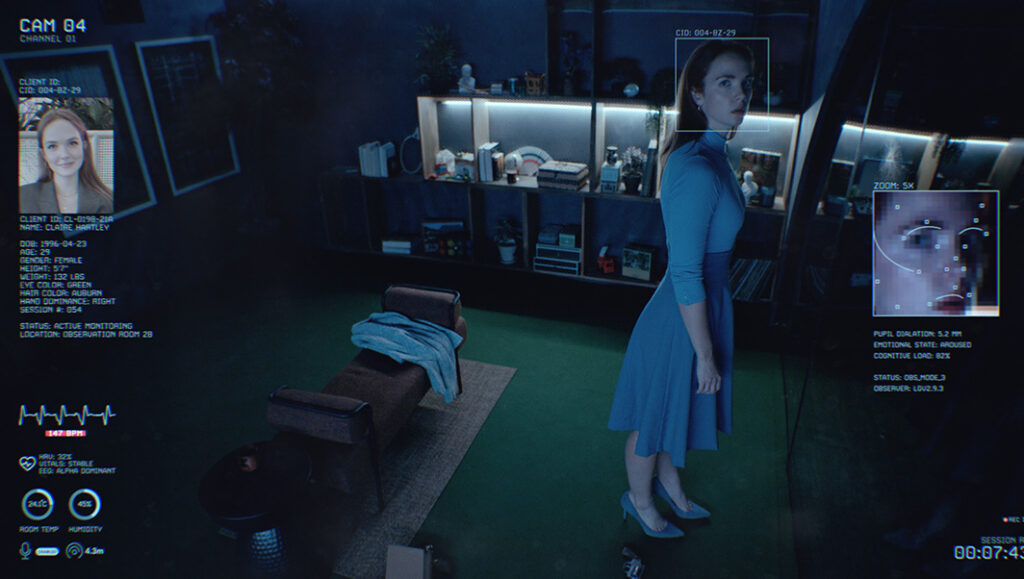
Among the many films premiering at the 2026 Tribeca Festival, few are as emotionally affecting as Holo. At its most effective, science fiction doesn’t ask audiences to marvel at technology; it uses it as a lens through which to examine the complexities of the human experience. Director Alexander DeSouza’s short film does exactly that, grounding its speculative premise in profound questions about grief, trauma, memory, and the elusive nature of closure. Anchored by a remarkable performance from Morgan Kohan, Holo is intimate in scale yet expansive in its emotional reach, finding extraordinary humanity within an unsettlingly plausible future.
When her abusive partner dies, Claire (Kohan) turns to Looking Glass, a company specializing in artificial encounters through the use of actors and advanced facial technology, in hopes of confronting him one final time and finding the closure that escaped her in life. What begins as a seemingly controlled therapeutic exercise gradually evolves into something far more emotionally and psychologically complex, forcing Claire to reckon not only with the man she lost, but with the version of herself left behind in the aftermath.
Following the film’s premiere, we spoke with Alexander and Morgan about building the emotional architecture of Holo, balancing drama, science fiction, and horror, bringing a character to life through both memory and technology, and why the film’s exploration of closure feels especially resonant in an era increasingly shaped by artificial intelligence.
PC: Alexander, you and writer Alexander Hernandez-Maxwell spent a lot of time discussing the film’s themes of technology and closure before production began. As both a standalone short and a proof of concept for a larger series, the film has to create enough intrigue for audiences to want to spend more time with these characters and this world while still delivering a complete emotional story. How did you approach striking that balance, and what discoveries emerged through collaboration with the cast and crew that helped shape the version of the story we see today?
Alexander: The short itself was lifted from what is now actually a feature film, so it evolved from a series into a feature. It’s representative of one of the sessions of Holo. When I first discovered the script and began working with Maxwell, it really came down to two things for me: the characters, and the ambiance, tone, and mood of the world because we’re alluding to something much larger. It led to a lot of careful conversations about shot selection, where we would shoot the film, and the references we wanted to draw from. I’m a very particular person when it comes to directing, as Morgan can probably tell you.
World-building was a major component of the process, especially in the first half. Where does it take place? When does it take place? Why is there so much nature? Why are circles such a recurring visual motif? Why is the dome circular? All of those were intentional decisions that we discussed because we’re building a larger world that will be explored further in the feature.
The second part was exploring the different layers within the characters. This is one of the few films, if not the only film, I’ve directed where there are three dynamics unfolding simultaneously. You have Grey portraying Jared. You have Jared and Claire. Then, at certain points, you have Grey and Claire. Those three relationships are constantly intersecting. That became a larger conversation with the cast about how to explore those dynamics and make each one feel distinct. A lot of that came through rehearsals, casting decisions, and the conversations we had early on about the characters.
PC: Morgan, there’s such a lived-in quality to your performance in this short. Did you have access to the larger body of work that Alexander was talking about? What was it about this character that resonated with you?
Morgan: Yeah, I did! They sent over the first episode, and that was incredibly helpful. It gave me a much broader view of the scope of the story and a deeper understanding of Claire. You can build out so much on your own, but having a clearer sense of the parameters and the larger world is always a gift.
In terms of what resonated with me about Claire, I was really intrigued by the shift she undergoes by the end. There’s the version of herself that she presents to the outside world, and then there’s the version of her that begins to emerge as she settles into interacting with Jared. Then, by the end, you see this glimpse of who she’d like to become. There was such a beautiful arc there, along with so many small details that made her feel incredibly human.
PC: Alexander, what’s fascinating about Jared is that even though he’s gone, he’s arguably the character we spend the most time trying to understand. Morgan carries the memories of who he was, Zelda Williams is recreating him through technology, and Shane West embodies his physical presence. How did you approach constructing a character whose identity is filtered through both memory and technology, especially when neither is necessarily a perfect reflection of reality? And what was the collaborative process like with Morgan, Zelda, and Shane to ensure that each interpretation revealed a different facet of Jared while still feeling like the same person?
Alexander: That is the million-dollar question because it was the most difficult part of the entire process. You essentially have one character split between two people. It really started during rehearsals. For Shane and Zelda, we went through the script and determined which actor would be driving each line. That became incredibly helpful later because I was also a co-editor on the film. When I was putting together the first rough cut, I had the flexibility to go back to the script and remind myself, “This actor was driving this line,” or “This emotional beat belongs to this version of the character.”
It also came down to how we shot the film. If we shot Grey first with Zelda and Shane on Day 3, for example, then once we wrapped with Zelda, a lot of Shane’s scenes suddenly became even more powerful. We were constantly making notes and reassessing things. We would say, “I really liked Zelda’s line reading here and the way she played this moment, but I think Shane is carrying Jared more strongly in this scene.” It became an ongoing conversation throughout production.
A lot of my job was mentally tracking where we were in the emotional arc of both Jared and Grey and deciding who was driving each moment. I literally had the script on my iPad and was marking it up with notes like, “This emotional beat belongs to Grey,” or, “This one belongs to Jared.”
PC: It’s cool to hear how your editing mind was working as you were directing.
Alexander: Yeah, maybe that’s because I’m an editor by trade. It’s a blessing and a curse. You want the freedom to discover things in the edit and allow the story to grow organically, but at the same time, I’ve found it incredibly useful to be aware of who’s driving a scene at any given moment. In one scene, it might be one character carrying the emotional weight, and in another, it’s someone else.
Both actors actually performed many of the same lines, so a lot of the decision-making came down to who we were using in the edit. Ultimately, it became a question of perspective. Whose point of view are we focusing on in this moment? That was something we were constantly evaluating throughout the process.
PC: Morgan, there’s so much restraint and nuance in your performance, and so many quiet choices that speak volumes about who this character is and everything she’s been through. She’s someone audiences connect with immediately, and there’s a vulnerability to her search for closure that pulls us deeper into the story. Can you talk about your approach to finding that balance between restraint and emotional expression, and how you got into the mindset of a character carrying so much beneath the surface?
Morgan: Thank you. That’s very kind of you to say. I journaled a lot as Claire, and I found that process incredibly helpful. I built out the timeline of her relationship with Jared, as well as her relationship with the company and where she was in her life when the story begins. All of that informed how she presents herself to the world and helped me understand the restraint she carries throughout much of the film.
At her core, though, her relationship with Jared was built on emotion, love, and vulnerability. As the story progresses and she chooses—or perhaps doesn’t fully choose—to lean into interacting with Jared again, those emotions begin to break through. That tension between the version of herself she’s constructed and the feelings she’s been holding onto became the foundation for how I approached shaping the character.
PC: Alexander, one of the things I found so compelling about the film is that while it’s ultimately a story about closure, there’s also an inherent sense of unease that comes from how close this technology feels to our own reality. Setting the story in the not-so-distant future allows the film to move seamlessly between drama, science fiction, and even horror at times. How did you approach balancing those different tonal and emotional beats so they could coexist cohesively within the same story, and how much of that balance was discovered or refined in the edit?
Alexander: It was probably 50/50. A lot of discoveries happened in the edit. For me, the best science fiction films are the ones that feel very quiet and almost play like dramas, where the science fiction elements become second nature. I wouldn’t even call Holo a science fiction film. To me, it’s a drama about two people searching for closure—one of them alive and the other not.
I’ve done a lot of dramatic work, so my first instinct was to make everything feel grounded, real, and genuine. I told Morgan and Shane that the first half of the film is essentially just a conversation. The situation itself is surreal, and you can see that on Claire’s face, but emotionally it’s still rooted in something very human. Then there’s a turning point when she says, “I just want you to say you’re sorry,” and everything begins to build from there. One of the earliest conversations I had with Morgan was about finding that switch—when Claire becomes fully immersed in the experience and reaches the point where all she wants is an apology or some form of closure from Jared. That emotional journey was my primary focus from the start.
The music and visual atmosphere helped a lot as well. The ambient lighting allowed us to incorporate some traditional science fiction elements without overdoing them. The script was originally much more cyberpunk, but I felt some of those elements were pulling attention away from what really mattered: two people talking to each other in a room. It became a constant balancing act throughout production.
Then, in post-production, the music selection became incredibly important. Our composer, Alexander Taylor, and I went back and forth quite a bit because I was also one of the editors. We were very deliberate about creating a soundscape that mirrored Claire’s emotional arc. At first, everything feels calm and familiar, but there’s a subtle uneasiness underneath it all. From there, the tone gradually evolves into something more unsettling as the story unfolds. That progression became the bridge between the drama, the science fiction, and the horror elements, allowing all three to exist within the same emotional experience.
Make sure to follow Alexander (Instagram) and Morgan (Instagram). Holo is now playing at the Tribeca Film Festival.
Photo Credit: Julian Lomaga

Discussion about this post