

Exclusive Interview: Drew Van Acker on the Layers of Truth, Subtext, and Empathy in ‘Orion’
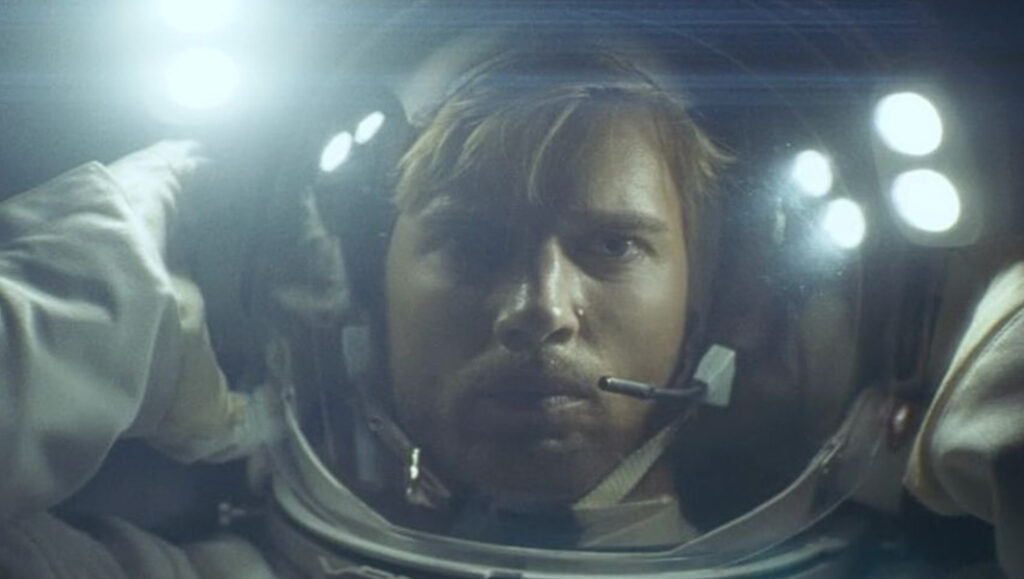
Drew Van Acker’s work in Orion reflects an artist increasingly deliberate about the stories he helps bring to the screen. Involved from the beginning as both star and producer, he anchors the film with a layered performance that gives its questions of truth and perception emotional weight. As Apollo, Drew finds as much meaning in what goes unspoken as in the dialogue, revealing a complexity that invites audiences to reconsider the character, and their own assumptions, with each viewing.
Directed by Jaco Bouwer, Orion pairs the intimacy of chamber sci-fi with the stakes of a mystery that reaches far beyond its confined setting. At its center is Apollo, the lone survivor of a disastrous space mission, whose fractured memories draw him into a tense interrogation with Andrew McCarthy’s character. As their exchanges expose competing versions of events, questions of survival give way to the unsettling possibility that Apollo’s return has brought something far more dangerous to Earth.
Pop Culturalist caught up with Drew to explore the truth, subtext, and empathy at the heart of the film. He discussed mapping Apollo’s psychological journey, finding freedom in his scenes with Andrew McCarthy, and the subtle choices that take on new meaning on a second viewing. He also reflected on the creative convictions guiding his work as an actor and producer, and shared what’s next, including an upcoming reunion with Lucy Hale.
PC: You’ve been involved in bringing Orion to life from the very beginning, and I love how our relationship with a piece of art can evolve depending on where we are in our own lives. As you’ve shared the film with audiences throughout its festival and theatrical runs, and now its digital release, has anything about the story taken on new meaning for you or resonated differently than it did in those early stages?
Drew: That’s a great question. As an actor, you’re only as good as your own imaginative experiences. Where you are in life plays a big part in how you bring certain characters to life. I had the luxury of being involved from the beginning, seeing it all get made and helping make it happen. I had time to adapt to Apollo. What’s so funny about that is that I, as Drew, was going through something in my own life where I was really struggling with this notion of what truth is and whether there’s a fundamental truth.
We’ve talked about this before, but as I go back and do these interviews, rewatch the movie, and go through certain things in my life, I sit there and think, “It’s so crazy to understand that concept, or to even consider that we can all have a different truth.” We all assume that reality is fundamental, right? And not to get too into the quantum physics of it all, but it’s absolutely not. Reality is subjective. Reality is perception. When you go back and watch the film and strip it all down, these are two people living in their own truth, with so much communicated through subtext. That doesn’t make one person the hero and the other the villain. People can do bad things. That’s obvious. But as we look at our geopolitical landscape and where we are as a society, there’s so much bullsh*t going on in the world. We have a lot of people who don’t see eye to eye and a lot of people who think they’re better than other people.
As you rewatch this film, one of the things I always want people to take away is a bit more empathy and understanding for each other. You, as Kevin, and I, as Drew, can have two completely different ideologies or truths. But it doesn’t make me right and you wrong, or me better or you better, or whatever it is. They’re just different. Once you understand that, it helps us empathize with each other a bit more.
To go back to your question, that’s something I was going through personally: how to connect a bit more with people I don’t necessarily understand. It’s pretty wild to rewatch it and go through that again.
PC: That’s such a great point. As audience members, we often go into a film wanting to identify the hero and the villain. But this script does a beautiful job of exploring the complexities of truth: how yours can differ from mine, and how that’s complicated further by what we want others to believe. It’s part of what makes the film so rewarding to revisit. How did you approach those layers in your performance, knowing certain choices might take on a different meaning on a second viewing? Without giving anything away, is there a detail you’d encourage audiences to look for that they might have missed the first time?
Drew: Yeah, it’s the subtleties. I can only speak for myself as an actor, but one of the things I love about acting and getting into the psychology of different characters is the subtext. We all have it. I have it right now. You have it. We all have this subtextual, subconscious dialogue going on in our heads at all times. What I love about this film is that, as Apollo, I got to play with that. I got to play with different levels of truth and subtext, depending on where I was in the story and how far I was willing to go to grab hold of Apollo’s truth.
Jaco [Bouwer] and I broke the script down into little pieces so we could remember where we were in the story and figure out whether we should filter in a little more here, or give a little more of an indication that this person was lying or telling the truth. We did get to shoot a lot in order, which was very helpful.
When you watch it again, I tell people to look for those little subtleties. I’ve seen the movie more times than I want to admit at this point, but Debby [Ryan] has them, Andrew [McCarthy] has them, and my character has them. This wasn’t something we all talked about. It’s just something we each brought to the story and our characters on our own. But there are little subtleties: little movements of the eyes, flickers of the mouth, and looks in certain directions.
One thing that comes to mind is a look between Debby’s character and mine that we held for a bit longer than normal. It’s my character speaking without speaking and her character speaking without speaking. But we’re both saying two completely different things.
I was telling a family member the other day, “When you watch it again, see if you can pick up on those little things. Your homework assignment is to relay them to me.” [laughs] And we’ll see if you’re right.
PC: As you were saying that, I was thinking about Apollo’s desire for connection and how that parallels the way everyone involved in this project seems so attuned to its subtext. Language is such a focal point in the film, and words carry so much weight. But there’s also this beautiful exploration of what’s unspoken and what can be conveyed physically. I know you use sound and journal from your character’s perspective as part of your process. How do those tools help you discover what your character communicates without speaking?
Drew: I feel like, to be an actor, you have to understand psychology. And to understand psychology, you have to understand that most of what we do as humans is without words. The words are almost the final piece of communication. [laughs] What’s so beautiful about this film is that there’s an exploration, or a meditation, on language and how it can hinder communication or help it.
If you know multiple languages, or you study someone who does, you’ll learn that they’re the best listeners. There’s a focus and a level of listening that I don’t think a lot of people have. What you understand when you’re fluent in a lot of different languages is that it’s important to pick up on little subtleties. It’s important to pick up on intonations in the voice.
I found it so interesting how the “language barrier,” as we call it, can be a barrier, but it can also be a bridge. That’s really important because there are so many aspects to understanding each other. I have my truth, but first and foremost, I have to be able to communicate that to you, and you have to be able to communicate yours to me, right? If we don’t have that bridge of communication, we’ll never get to a place where we can understand each other’s truth.
It’s really fascinating to watch people and try to learn. I got to do a little bit of that, to the best of my ability, by learning phrases in Mandarin and Russian. It’s really cool because I took Spanish, French, and Latin in school, but I’m not fluent in any other language. To spend some time with these languages was really cool.
PC: There are several scenes where you and Andrew have these intellectual debates, and Jaco’s use of close-ups makes it feel as though your characters are speaking directly to the audience. As those exchanges intensify, the pace of the dialogue quickens. What were your early conversations with Andrew about finding that rhythm and tension, and how did you support each other’s performances when you were off camera?
Drew: What’s beautiful about Andrew is that he’s such an immensely talented actor. He’s so good at what he does. We didn’t have a lot of time together to rehearse or choreograph our movements in these tight little spaces and rooms. But what’s beautiful about him is that his process is very free. I don’t ask people about what they do in the comfort of their own home or what their process is the morning of or the night before. But on set, he doesn’t want to know too much. He doesn’t want to over-rehearse, over-choreograph, or overdo certain scenes. Because so much of it is him and me in a room, and so much is psychological and rooted in subtext, we had to find ways to keep it interesting, not just for the audience but for ourselves. How do we keep each other on our toes? One of the ways we did that was by keeping each other guessing.
He and I talked with our writer, Anne [Vithayathil], and Jaco. We had a lot of fun finding different ways to approach what was going on in a scene while keeping its bones intact. If we did a straightforward version on take one, by take three, we were both going in different directions but trying to find each other in the middle. I felt that was really cool because it allowed us to be free and open.
Jaco was very gracious and patient. You don’t always get a lot of time and patience on films with budgets of this size. We were really lucky to be able to play with each other without overdoing it, discover each other’s nuances, and find what made us react to each other, both as Drew and Andrew and as Apollo and Jim. What made him tick? That goes back to the psychology of it all, and it was fun to watch that unfold as we went along.
We got to shoot a lot of it chronologically, but there were other scenes we didn’t. Both of us had to remember where we were in the story so we didn’t give too much away in our faces or eyes, or play into the lie or the subversion. It was really cool to explore that together with Andrew and Jaco. We had this fun little trio of freedom and play. It was nice.
PC: It feels like a sparring match. There’s such intensity between you and Andrew, but also so much restraint, that you’re on the edge of your seat watching the dialogue unfold. Speaking of that confined space, the sound design gives this chamber sci-fi film such an immersive quality. On my second viewing, I had an even greater appreciation for how every echo and subtle movement adds to the tension. How did sound inform your performance on set, and what surprised you about the way the finished soundscape amplified it?
Drew: I’m a huge fan of sound design and sound in general. I did a lot of voice recording and journaling as the character through audio recordings. I play them over and over. When I’m not listening to those, I also love listening to instrumentals and binaural beats, especially for a project like this, which felt like low C notes and low-frequency music. I found it resonating deep within my chest, in my sternum, in my solar plexus. I used a lot of that to connect with the alien because, when we were filming, we didn’t have an alien to work with. You don’t have the sound design funneling in. But Jaco was so great about playing instrumentals and sound design for me to draw inspiration from. When you’re filming, you don’t know what the end product is going to be.
We had talked a lot about the sound design, the score, karin ann’s music, and how all of that would be part of it, but you don’t know how it’s going to play until the final edit. On the day, it was nice to have some of those auditory cues. I felt like they informed who this alien was and added a level of coldness to the atmosphere for my character. I felt very cold in my environment and in my body. I felt frigid, which I thought added something nice to that claustrophobic feeling. From my character’s perspective, you don’t know where you are. You don’t know what country you’re in.
Sound is so important to us as humans. Not to go too in-depth on this again, but we have thousands more synapses from the ears to the brain than we do from the eyes to the brain. So a lot of people believe sound is ten times more important than sight for the human body. But that’s another conversation. [laughs]
When you see it with the music and sound design, it adds a level of depth to these characters. When Apollo’s walking through the hallway, there’s this eerie tone that I felt was so perfect because it didn’t overdo it or take anything away. A lot of times with thrillers or horror films, you feel that pulsing. So much of the score and sound is there to draw something out of the audience. That adds to the performance. I felt like we handled that very subtly, without overdoing the sound design. I’m very happy with it. It helped my performance in a lot of ways.
PC: You mentioned breaking Apollo’s journey into four parts. On my second viewing, the Russian dolls felt like a reflection of those layers being revealed. It’s those subtle details that make the film so rewarding to revisit. Without giving too much away, can you talk about mapping out those four stages, the intention behind each, and how you connected them into one cohesive journey?
Drew: Totally. When Anne’s draft came in, I loved the matryoshka dolls and how they represent the story and the pulling back of layers. The four sections we created were really there to help me stay grounded in the performance. I wanted to be truthful in each moment and not get too far ahead of myself or too caught up in thinking, “This is where the story is going, or this is where it’s been,” because the audience doesn’t know that yet.
I broke it down into, “Where are we right now? Okay, we’re in quadrant one. Now we’re in quadrant two, three, four.” Each moment had to be genuine and truthful to what was happening between these two characters, while making sure I didn’t give too much away.
For example, you and I can have this conversation, and you can ask me a question that I can answer in three or four different ways. Subtextually, there’s a lot going on. If you’re doing your job as an actor, you’ll see little things behind the eyes. When we first started filming, I felt like I might have been holding back a bit in my performance because I didn’t want to give too much away.
Then I found myself going into other takes thinking, “I really want to play with the audience a bit and mess with their sense of what they think is happening right now.” That’s when we broke it down into four sections, because there’s a lot going on in Apollo’s journey.
We also wanted Apollo to find a bit of himself along the way, rather than have a plan from the first moment and reach the end with that plan realized. We wanted his journey to be less of a straight line. We wanted him to think at times that maybe he’s the villain. Maybe he’s not the good guy he thinks he is. Maybe he’s not as righteous as he thinks he is. We wanted to play with that a bit.
Breaking it down into those four sections really helped. It also gave Jaco and me a shorthand on set. We could talk quickly about which quadrant we were in, and that would get me right back there. Then we’d go back to it.
Without giving too much of that process away, as creatives, it’s really nice to have something to fall back on. It made me feel comfortable as an actor and safe working with him, knowing we had that framework. Everything else became about being free to play.
PC: It’s been exciting to follow your journey as both an actor and a producer, and to see the stories you’re choosing to bring into the world. What’s in the works that you’re able to share, and how do those projects reflect your values as an artist and what you want your body of work to represent?
Drew: One of the major chapters in my career has been focusing on independent film and making that leap into producing. I might turn down a couple of things here and there. I might forgo a lot of money to chase something that gives me a little more creative freedom and feels more inspiring to me. The projects I do aren’t just vehicles for myself. They’re not just launching pads for me. They’re not ego-driven. They’re the stories we want to tell.
At the end of the day, with a project like Orion, I hope people have conversations in their cars on the way home and talk about truth. They talk about empathy. They can look at each other and have a little more understanding that we don’t always see eye to eye, but that doesn’t mean I’m right and you’re wrong.
For me, I just want to be part of stories that make me call my manager or agent and say, “Hey, I just read this script. I have to be Apollo. I have to be this character. I’ll fly to South Africa and knock on Jaco’s door to be part of this.”
Sunil [Perkash] and I have a couple more projects we’re doing. We’re trying to get one off the ground early next year that’s going to be absolutely incredible. Lucy Hale and I are re-teaming after Pretty Little Liars. We’re going to do a beautiful coming-of-age drama with one of the best scripts I’ve ever read. I think she agrees with me on that. We’ve had many conversations over the years about doing something together. I reached out to her and said, “I need you to read this. I think you’ll really like it. I think you would bring so much life to this character.” She did, and we’re going to get that going early next year.
There’s another one I’m doing that I can’t give too much away about, unfortunately. I’m so sorry. I hate this as an actor. [laughs] But it’s a neo-noir psychological thriller. It’s almost like Seven meets Watchmen, in a way. It’s very cool. We developed all of that ourselves from the ground up. I’m really excited about it. I’m sure you and I will be talking again. I hope so. Next year is going to be really fun.
To keep up with Drew, follow him on X and Instagram. Orion is available now wherever you stream movies.

Discussion about this post