

Exclusive Interview: Tyson Apostol and Tom Sandoval Talk ‘House of Villains’ Season 3, Brotherhood, Strategy, and More
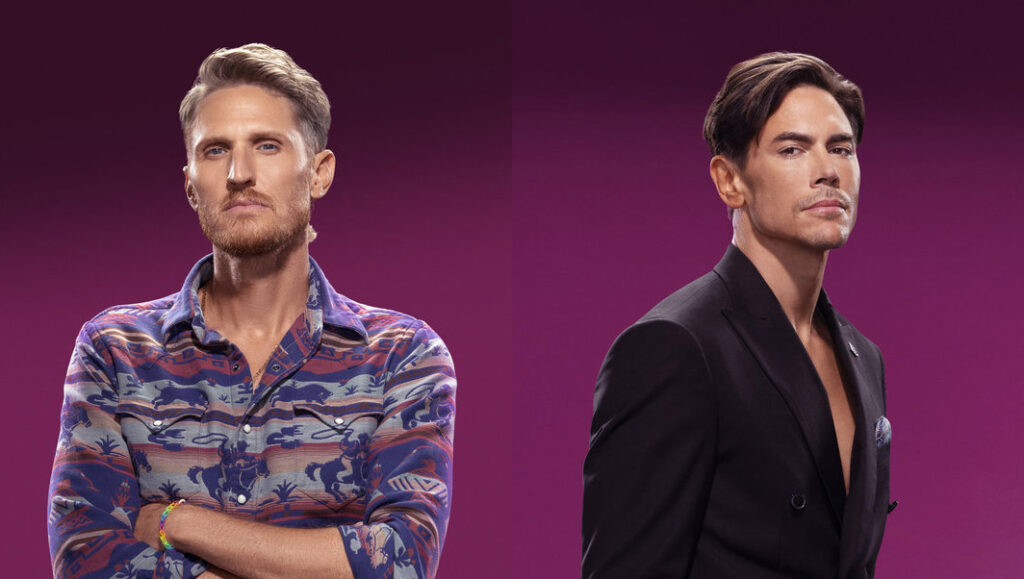
Tyson Apostol and Tom Sandoval may come from very different corners of the reality TV universe, but both arrive at House of Villains with skill sets that immediately command attention. Tyson’s legacy on Survivor and The Challenge speaks to his strategic pedigree, while Tom’s relationship-first instincts—built on Vanderpump Rules and tested on The Traitors—make him a uniquely social player in a game built on perception. Put them together, and it quickly becomes clear their early-season bromance might just be one of the house’s most effective alliances.
Set inside a house where chaos is currency and trust is always temporary, House of Villains challenges some of reality TV’s most notorious personalities to outmaneuver, outlast, and outplay one another for the title of ultimate supervillain. With the ever-looming Hit List and power constantly up for grabs, the game rewards those who can balance bold moves with careful relationship management—a tightrope Tyson and Tom quickly recognize they’ll need to walk together.
Pop Culturalist caught up with Tyson and Tom to talk about embracing their reputations, finding the sweet spot between strategy and social gameplay, and why sometimes the smartest move in the house is simply aligning with the right partner.
PC: Tyson, you’re one of two former winners in the cast. Was that something you felt was already on people’s radars coming in? Did you make a conscious choice to lean into that reputation or try to step away from it, especially with the split between gamers and non-gamers in the house?
Tyson: I think I was too well known to distance myself from it, so I had to lean in. Something that’s unique about this show is they let you have your phones at night, so I knew people were doing their research. Kate [Chastain] is probably perving on my Instagram nonstop. So I figured I just had to embrace it—there was no way to separate myself from it. It was like, “It is what it is. I’m going to lean in and go hard. That’s it.”
PC: That you did. Tom, I think it’s time you start acknowledging yourself as a gamer—from The Traitors to House of Villains, you’ve more than earned your stripes. You’ve said this is one of your favorite experiences so far. Were there elements from The Traitors that you were able to bring into this game? And what made this season so special for you?
Tom: Yeah, having the experience from The Traitors definitely helped because it wasn’t my first time coming into something like this, but it’s a very different game. Traitors is much more dramatic and theatrical. In some ways, you feel like you have less control over your outcome because you could get murdered just to throw people off—or for any reason. You can get banished too, but at least in that situation you get to fight for yourself.
What’s so cool about House of Villains is that you really have a chance to connect with people. On Traitors, you’re working to add money to the pot. But on House of Villains, you’re working to become the supervillain and stay off the “Hit List,” so it feels like you have more agency. Your relationships can actually help keep you safe. Plus, with the redemption challenges, you have opportunities to pull yourself off the Hit List and avoid elimination. That made it really fun.
Also, the show doesn’t take itself too seriously—it’s very meta. Joel McHale is a very different host than Alan Cumming, and both are great in their own ways. Overall, it was just a really fun experience where it felt like building strong relationships could genuinely move you forward in the game.
PC: Definitely—it’s the perfect blend of competition and campiness. Tyson, I love hearing your game analysis on your podcast, and what makes shows like this so fun is how they continue to evolve each season. Was there a move this season—whether made by you or someone else—that you think will impact how future players approach the game? And if you could add a twist or element to make the format even more strategic, what would it be?
Tyson: Definitely. Watching previous seasons, it’s a very tricky balance when it comes to being the supervillain. I actually think not winning supervillain is better for your game—unless you’re in a do-or-die situation with your back against the wall.
One thing I would change moving forward is incentivizing people to win supervillain. Even watching the first two seasons, I was like, if you win supervillain, you’re forced to draw a hard line and create enemies. No one really wants to do that. But if there were a strong incentive, you’d force people to step into those situations.
Early on, in the Toxic Tea Party competition, you see Tom purposely not wanting to be supervillain, which I actually think was the right move there. But if Tom were incentivized to take supervillain—even at the detriment of his own game—now you’ve got some added conflict and drama.
Tom: I feel like the best place to be in this game is close with the person who does win supervillain. There were definitely people who really wanted that title. So it became important to align yourself with those people and stay on their good side to make sure you don’t end up in the bottom three.
Tyson: Yeah, I agree. If you can stay on everybody’s good side and they win supervillain, that’s the sweet spot.
Tom: I also think it helps to be a good bartender and make cocktails for people at night.
Tyson: I can’t do any of that. [laughs]
Tom: [laughs]
PC: I knew being a bartender was part of your strategy. In addition to that, you’re also a musician. If you had to pick a song that encapsulates this experience, what would it be and why?
Tom: Oh my gosh.
Tyson: Anything by Bon Jovi.
Tom: “Black Hole Sun” by Soundgarden. [laughs]
PC: I also love the bromance that we get to see form between the two of you really early on. How does the other complement your gameplay?
Tyson: For me with Tom, I just needed someone to bounce ideas off of—or bring ideas to me—so we could work in tandem and ask, “What should our next move be as a pair?” With a pair, you have two votes. That’s a lot in a house of eleven people. Two out of eleven, and then you just need to gather three or four more.
Tom: Exactly. Bouncing ideas off each other was huge, especially with someone who has such great gaming experience. And on my end, coming from the restaurant industry and a show like Vanderpump Rules, my strength is more about the interpersonal relationships—connecting with people and being social. That helped balance Tyson, who is more game-focused. We had a nice mix of the social side and the strategic side. Plus, we’re totally awesome.
Tyson: We were super funny. When I go on a show, I want to have fun—and with Tom, it really was a lot of fun. That makes the experience worthwhile. When you look back on it, regardless of what happens in the game, there’s something positive to take away. Tom definitely had that same mindset of just wanting to enjoy the ride.
Make sure to follow Tyson (X/Instagram) and Tom (Instagram). Stream House of Villains on Peacock.
Photo Credit: Art Streiber/Peacock

Discussion about this post