

Exclusive Interview: Tom Felton on World-Building, Timely Themes, and Suiting Up for ‘Altered’
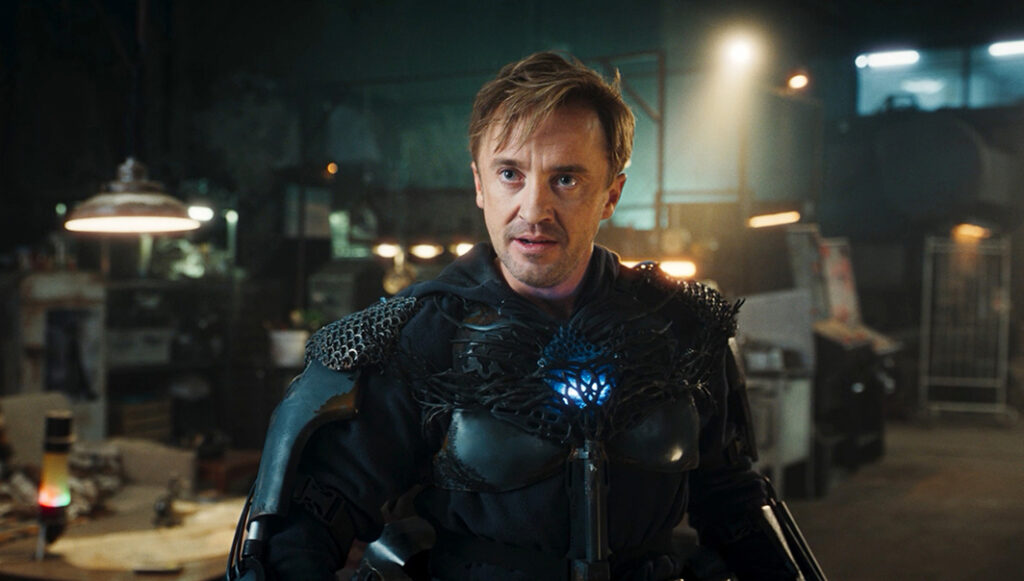
There’s a magnetic pull to Tom Felton on screen—one that Altered amplifies as he guides audiences through a sci-fi world where invention becomes survival and humanity is put to the test. Tom taps into sharp humor, resilience, and an inventive spirit as Leon, a rebel determined to carve out a place for himself and those like him in a future that feels unsettlingly close to our own.
In the hands of visionary writer-director Timo Vuorensola, that future is realized with striking detail. After nuclear war reshapes the planet, genetic enhancement becomes the new standard—leaving a marginalized population of “Specials” scrambling to survive. Leon’s brilliance and underground workshop give them a fighting chance to navigate a society built against them. By his side is the fiercely talented Elizaveta Bugulova, who delivers a breakout performance as Chloe—the orphan he protects and the spark who keeps his mission alive.
Pop Culturalist was lucky enough to catch up with Tom to learn more about building this dystopian world, suiting up for a new kind of sci-fi hero, and why Altered uses genre to explore some of today’s most timely and universal themes.
PC: The way this film uses the sci-fi genre to spark conversation is so compelling—it’s intentionally eerie, like a glimpse into a future or alternate universe that doesn’t feel too far off. What was it about that approach, and this story as a whole, that made you want to champion it not only as its lead but also as a producer?
Tom: Exactly that. There are so many parallels to what we’re experiencing now. One of the great things about genre is how it can make you feel like you’re watching something completely unreal, when in truth, the themes and analogies are deeply human and universally relatable. A film like Jurassic Park is essentially a lesson in “Don’t play God.” There are so many ideas within this film that I hope audiences connect with.
PC: There’s such a delicate balance of strength and vulnerability when it comes to Leon and everything he’s experienced in life—yet he still finds moments of levity and humor. There are scenes where his emotional depth hits you right in the core, and others where you’re laughing right along with him. His connection with his mother is so deeply rooted in who he is, even though we don’t fully see that relationship play out on screen. How do you create the space to tap into his emotional complexity while also honoring those lighter moments and bringing them authentically to the screen?
Tom: Timo and I talked a lot about that backstory with his mother. A big part of what actors do is build a whole internal world for the character—even if you don’t actually see it unfold on screen, you can hopefully feel it through their eyes and behavior.
This is such a heartfelt piece, with so much tied to family, politics, and global ethics. But then there are these wild action elements too. One morning, I’d be reading a letter from my deceased mother, and by the afternoon I’d be flipping cars and shooting flowers out of my suit. That’s definitely a first for me. [laughs]
PC: There’s such a striking visual identity to this dystopian world, especially in how the set design and costumes clearly distinguish the Genetics from the Specials. How did being immersed in those environments—particularly when stepping into the exoskeleton and suit—help you tap into your character’s mindset and physicality within this class-divided society?
Tom: It’s everything. Naturally, when you put a wizarding robe on, you become a wizard—and it’s the same here. We rarely used green screen, so being able to fully immerse myself in this world made the transformation so much easier. Then you add the practicality of the suit. I can’t speak highly enough of the team who made not only the stunts look so cool, but also the suit itself. I imagine it was incredibly challenging to design something that allowed full movement without looking plastic or overly bulky. They nailed it.
I did wonder, “How am I going to show emotion in scenes while wearing a mask?” But the design was so clever that even without seeing his face, you can still feel what Leon is experiencing under that helmet.
And it’s one thing to read a setting on the page, but another to walk onto set and be transported instantly. Leon’s workshop isn’t just a studio build filled with props—they found this old, abandoned sawmill and layered in the details. When you’re inside it, you truly feel like you’re in Leon’s lab.
PC: I was just going to ask about that practicality. How early in the process did you begin working with Leon’s suit, especially since it adds a new physical layer to how he navigates the world? And as you spent more time in it, were there any discoveries that helped you respectfully reflect his journey—learning and adapting?
Tom: I was amazed by how many times it didn’t break. [laughs] Leon is definitely more comfortable in the suit than I am. I took a few knocks—when you’re falling to the ground or getting smashed into cars, there’s only so much you can control. [laughs] You keep waiting for the whole thing to explode into a million pieces, but it held up incredibly well.
In terms of physicality, the biggest difference is that Leon uses a wheelchair. We put a lot of care into portraying that authentically. One of my dear friends, David Holmes—who’s a paraplegic and worked on the Harry Potter films—was incredibly generous in helping me understand how someone relies entirely on their upper body, and what it might feel like to suddenly have a machine that gives you mobility in a completely new way. We really leaned into showing Leon adjusting to that shift.
PC: I love the dynamic between Leon and Chloe—how they challenge each other to grow, and how their relationship evolves as the film goes on. In what ways did working with Lizzy push you to be a stronger actor, and what was that collaboration like as you built that evolution together?
Tom: Honestly, it’s one of my favorite collaborations I’ve ever had—on screen or off. I’ve never played someone with a little sister before. Her character can be annoying and bratty, but she’s also incredibly smart and resourceful, which was so much fun to play against. In real life, I have three older brothers, so I know that dynamic well—it usually means nonstop teasing as a form of affection. [laughs]
Lizzy is unbelievably talented. English isn’t even her first language, yet she grasped the entire world of the film and the emotional journey so effortlessly. She’s a master. She comes to set happy, prepared, full of ideas, and completely committed. It’s rare to see someone so young have that level of professionalism and enthusiasm while also being able to muck around with me constantly. We got told off more than a few times for laughing too much. [laughs]
PC: There’s so much world-building in this film, and Timo not only wrote it but directed it as well. What’s it like stepping into a universe that the person behind the camera actually dreamed up? And have there been any early conversations about continuing the story?
Tom: You’ll have to ask him, my friend—otherwise I’d have to kill you. [laughs] Honestly, I don’t know. But Timo had such a clear vision from the start. There was so much trust there. He adores this genre and knows it inside and out. He understood this world long before the cameras rolled; he’d talk endlessly about the tiny details and the history of this universe that we don’t even see in the film. That’s how invested he is.
So you can imagine how thrilled I was when I finally saw the finished product. I can’t imagine why he wouldn’t want to keep telling stories in this world.
To keep up with Tom, follow on X and Instagram. Altered is in select theaters now.

Discussion about this post