

Filmmaker Freddy Macdonald and Star Calum Worthy on the Emotional Threads That Bind—and Break—in ‘Sew Torn’
A lone button. A briefcase. Three impossible choices. In Sew Torn, filmmaker Freddy Macdonald crafts a genre-bending tale where even the smallest decision can spiral into chaos. At the heart of the story is Barbara Duggen—better known as “The Mobile Seamstress”—who stumbles into a drug deal gone wrong while chasing down a missing button for a client. Faced with two bodies, a gun, and a case full of consequences, Barbara must choose between committing a crime, calling the police, or simply walking away. What unfolds is a cinematic triptych that explores the fallout from each path—each more dangerous than the last—as Barbara fights to save her store and her sanity, one thread at a time.
Inspired by a short film Macdonald created for his AFI application, Sew Torn threads together thriller, dark comedy, and emotional realism with surprising finesse. Co-written with his father, Fred Macdonald, the film expands on themes of choice, consequence, and control—both literal and emotional. Anchored by Calum Worthy’s vulnerable performance as Joshua, a young man caught in the crosshairs of family legacy and personal reckoning, the film unfolds with escalating tension and unexpected tenderness.
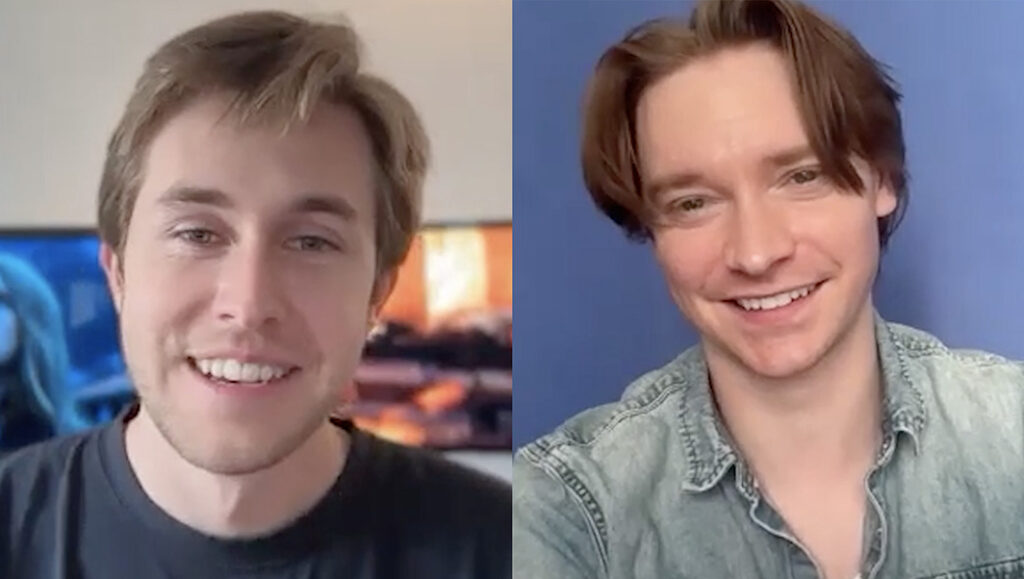
Pop Culturalist sat down with Freddy Macdonald and Calum Worthy to explore the film’s tonal tightrope, the immersive approach to performance, and the emotional scaffolding that holds Sew Torn together. From fifteen-minute takes to cardboard props, from chaos to catharsis, the two reflect on building a world where every thread—and every choice—matters.
PC: I was drawn to how the film explores the choices that shape the paths we take. For both of you, what was the pivotal decision that set you on your creative journey—and what led you to write or star in this project specifically?
Freddy: That’s such a great question. As you said, the film is all about choices. I can trace this project back to one defining moment in my life: deciding to go to film school. The feature is actually based on a short film of the same name, which I created as part of my application to AFI. The prompt was to tell a five-minute story about a change of heart. My dad and I—he’s Fred Macdonald, I’m Freddy—were brainstorming together. We’ve always collaborated; he taught me stop motion animation when I was nine, so storytelling has always been a shared language between us.
Calum: A big choice for me was right off the heels of high school. I’m an environmentalist, and there was a moment where I thought maybe I’d go into that field full time—or maybe part time—while I figured out the rest. At the same time, I wasn’t sure what kind of acting projects I should do next. I’d done some independent films and was on a Canadian TV show for a while. I heard Disney Channel was interested in having me do something with them—I had worked with them the year before.
There was a pilot called Austin & Ally. I knew they were interested in me, but I decided to go in with this bold, kind of crazy character. I thought it would be really fun to play. It was a big risk because they could’ve been like, “What are you doing? You sound insane right now.” But I was like, “I’m going to do this.” I drew this giant poster of one part I was supposed to talk about. I had this idea, and I was like, “I’m going to present it. It’s going to pop down and be this big moment.” It was definitely out there—but luckily, it worked out. I think both the decision to keep going in this business and taking that bold swing with Disney Channel were huge turning points for me. They completely changed the trajectory of my life.
PC: That’s such a great lesson in making bold choices in your life and career. Freddy, tonally, you’re navigating so many different spaces. The film is part thriller, part dark comedy, but it’s always grounded in reality. How did you find that balance as a co-writer and director? How much of that tone was discovered in the edit? Were there any discoveries made during that process?
Freddy: It was a long journey to find that balance. It was definitely tricky. We wanted the film to feel grounded to an extent—especially because some of the schemes my dad and I literally built in our backyard, using thread and cardboard guns, and made them happen practically. But at the same time, we had to lean into this heightened world and ask the audience to suspend their disbelief—believing we’re in Switzerland, in this fictitious town, with an international cast. So it was always a balancing act between those extremes, while also grounding the film in an emotional throughline for each character. That tension was always there.
Even in the edit—I spent ten months cutting the film—I was constantly chasing that balance. I drove myself a little crazy doing test screenings. I tried almost every note I got: rearranging scenes, cutting the film down, extending specific beats. It was exhausting but also exciting, because it felt like I was working within a tonal space I hadn’t really seen before. And that was really fun to explore.
PC: It’s a masterpiece in diving into all those different tones and genres. Speaking of the groundedness—Calum, when you strip Joshua’s story down to its core, it’s so incredibly relatable, especially his desire to carve his own path instead of following the one his father expects of him. With Freddy as both co-writer and director, what were those early conversations like around Joshua’s backstory? And how do you bring your own perspective to the role and discover where this character lives within you?
Freddy: That’s a fantastic question.
Calum: Yeah, it’s a great question. Freddy, go ahead.
Freddy: You’re incredible in this. It really is a great question, because Joshua was such a fun character for my dad and me to write—especially since this is, in many ways, a father-son story. It’s also a mother-daughter story, but we’ve always been drawn to exploring parental dynamics in our writing. A lot of people watch the film and come up to me like, “Oh my God—does your dad beat you or something?” [laughs] And I’m like, “No! We actually have the best working relationship.” He taught me stop motion when I was nine, and we’ve been co-writing ever since. We have nearly identical taste, so we never butt heads, but we’re both fascinated by the complexity of parent-child relationships.
He was actually really nervous about me getting into film. He’d worked in the industry and didn’t want to push that path on me—he was super self-aware about it, even when I was in high school. He’d always ask, “Are you sure this is what you want?” That hesitation was coming from a good place, but it stuck with me. We wanted to take that insecurity and exaggerate it in Joshua’s story—to explore what happens when the pressure and expectations become too much. So I really appreciate you picking up on that—it’s deeply personal for both of us.
PC: Calum, do you want to add anything?
Calum: I was also surprised. I’d known Fred and Freddy for about two years before I ever saw the script. I’d worked with them and had seen firsthand how strong their relationship is. They’re amazing collaborators—not just as father and son, but as a creative team. Their writing is unparalleled. What really struck me, though, is that they chose to explore a version of their relationship that’s the complete opposite of what they’ve actually experienced.
Even in these heightened worlds and extreme situations, the stories resonate most when they come from a truthful place. The fact that they decided to tell a story about a father and son—and also a mother and daughter—was so powerful and impactful.
Freddy is such a great director to work with because he really met me where I am. I like to stay in character on set. Some people call it method—I don’t know if it’s method, but for me, it just feels like dedication. I want to stay fully in it and not waste any energy outside of the character. Freddy totally embraced that, and I was really grateful for the space he gave me to fully live in the role. And that was true across the board—for Eve [Connolly], K Callan, and John [Lynch], too. We were all able to immerse ourselves even more deeply in our characters than we normally might on a set.
PC: The use of genre allows audiences to disarm themselves and let those bigger themes hit even harder. That’s the perfect segue to this question I had for Freddy. It’s so interesting that half of the ensemble are people you’ve worked with before, and the other half you’re collaborating with for the first time. Calum has spoken so highly about your ability to recognize that every actor has their own process. How does that approach differ when you’re working with longtime collaborators versus those you’re getting to know?
Freddy: It’s really fun to learn new ways of working, but there’s also something so comforting about working with people like Calum because we already have a shared language. Calum was in my AFI thesis film, as was K Callan, so they already had great chemistry and understood how each other liked to work. Thomas Douglas—the motorcyclist with the helmet—was also in the short. He had to lay in the exact same position on the road five years later. He told me it was a surreal experience, but he knew exactly what he was signing up for.
With everyone else, it really felt like we were building a new family. That was one of the most rewarding parts—figuring out how to meet each actor where they were and create that sense of trust. Caroline Goodall, for example, was someone I was nervous to direct. She’s worked with [Steven] Spielberg twice—on Schindler’s List and Hook—so I was a little intimidated. I’ll never forget her pulling me aside one day and saying, “If we were shooting this scene with Spielberg, we’d have three days. Not thirty minutes.” And I was like, “I know, I’m sorry! We’re running on adrenaline here.” [laughs] But we all figured it out together. It was a lot of fun building this Sew Torn family.
PC: You can feel that in the performances. Calum, the shifting tones also mirror your character’s emotional arc. When it comes to those more vulnerable beats—especially between your character, his father, and Barbara—how do you create that space to access those emotions? And how much of that is about feeding off what your scene partners are giving you?
Calum: It’s everything. I really believe that if there’s ever a good performance, it’s because of the other actor in the scene and the director giving you the space to go there. In my case, John was so scary—I was basically just reacting to him scaring the hell out of me. [laughs]
John and I didn’t really get to know each other before we filmed. We only got to know each other after the project wrapped, and that ended up being the best thing. We both really wanted to approach the scenes in a genuine, authentic way, and honestly, I’m glad we didn’t connect beforehand—because he’s actually such a kind, friendly guy. If I’d known that, it might’ve been harder to be intimidated by him on set. After our last day, we went out for a beer and finally bonded. But up until then, I was low-key nervous to work with him because I’d been a fan of his for so long—and he’s absolutely terrifying in this role.
We both stayed in our characters’ worlds before filming those scenes, and Freddy was incredibly gracious in giving us that space. The whole crew supported that atmosphere. We did these long, emotional takes—one of them was fifteen minutes straight. Freddy was like a conductor. Because the take was so long, we couldn’t cut within it, so he and Sebastian, our amazing cinematographer, were guiding not just the visuals but our emotional arcs, too.
And yeah—afterward, finding out John’s this warm, lovely guy? Hilarious. I was terrified of him for a week.
PC: He’s such a presence. That diner scene toward the end is one of the best things I’ve seen all year. You all shot that in such a practical way. Freddy, from a filmmaker’s perspective, why was it so important to approach that scene realistically? And how did you pull it off? Calum, from an actor’s point of view, how valuable is it to fully live in the moment without having to rely on your imagination?
Freddy: I was most nervous about the diner scene. Like Calum said, he and John were both fully in character. I felt like I was walking on eggshells with both of them—trying to give Calum his space, and also being mindful that even when the camera wasn’t rolling, John was still in it. Everyone on set was committed to protecting that authenticity and creating the space for them to go there emotionally.
We intentionally designed that scene to let them breathe and play, which is why we stripped down our shot list and kept things really simple. The rest of the film is very insert-heavy and full of quick cuts, but this was the moment to slow down and just let the characters exist. Like Calum mentioned, we did two fifteen-minute takes—one on John and one on Calum. And they both nailed it on the first try. Honestly, it was easy for me. I just got to sit back and watch these two incredible actors live in the moment. It was really special. I’ll never forget it.
Calum: I think it was the most immersive experience I’ve ever had on a set. Because the takes were so long, you completely forget the camera is there. You’re not acting—you’re just living it. Even in the time leading up to the scene, we made sure to stay in that emotional space. And honestly, I don’t remember a lot of it. It was surreal. Since everything was done practically, there was nothing to imagine—we were just there. I remember coming out of it and thinking, “Wait, we already shot that?” It was that deep.
It was such an emotional experience, and that’s rare—especially on a tight shooting schedule. You don’t always get the time to really sit in a moment like that. Freddy’s an incredible filmmaker because he knows when it’s important to create that space. As an actor, that’s the dream. It means you can give everything in one take, because you’ve been given the chance to truly immerse yourself.
Make sure to follow Freddy (Instagram) and Calum (Instagram). Sew Torn is out in select theaters and available on VOD on June 13th.

Discussion about this post