

Benjamin Evan Ainsworth and Jack Champion on Identity, Insecurity, and Finding Yourself in ‘Everything’s Going to Be Great’
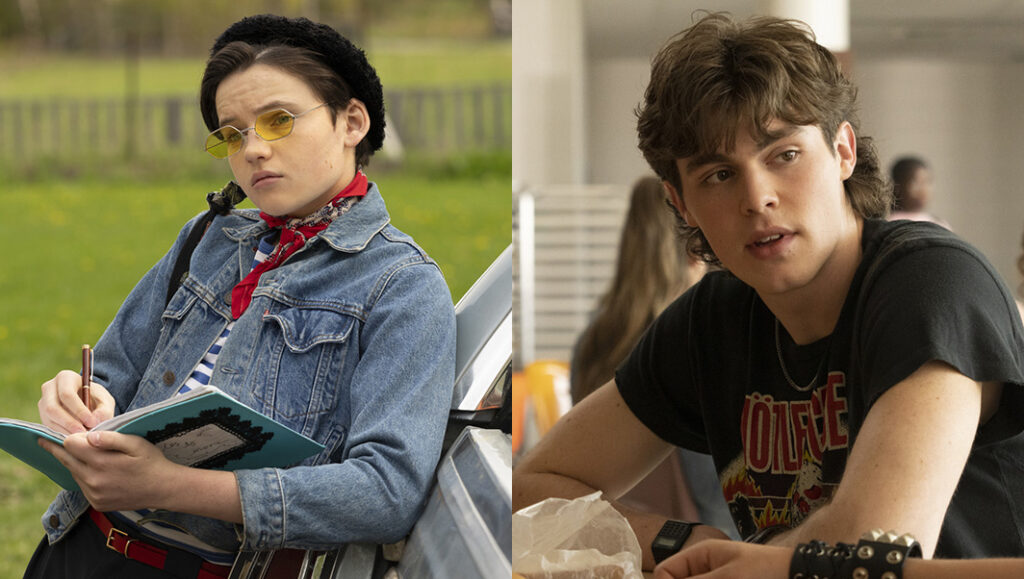
Benjamin Evan Ainsworth and Jack Champion are two of the most captivating young actors of their generation, and in Everything’s Going to Be Great, they prove it with performances that are as raw as they are revelatory. Even alongside screen legends like Bryan Cranston and Allison Janney, the pair carve out a space entirely their own—commanding the screen with quiet intensity, unexpected humor, and the kind of emotional precision that leaves a lasting imprint. Together, they bring to life a story of brotherhood and identity that feels both intimate and epic in scope.
In Everything’s Going to Be Great, Bryan Cranston and Allison Janney star as Buddy and Macy Smart, a pair of regional theater veterans chasing the spotlight while trying to keep their family intact. Their sons, Lester (Benjamin Evan Ainsworth) and Derrick (Jack Champion), couldn’t be more different—one a theater-obsessed dreamer, the other a quietly conflicted athlete—but both are navigating what it means to belong in a world that often misunderstands them. As the Smarts stumble through rehearsals, rivalries, and revelations, the film becomes a tender and often hilarious portrait of a family learning to embrace each other’s contradictions and find joy in the chaos.
Pop Culturalist sat down with Benjamin Evan Ainsworth and Jack Champion to discuss their transformative roles in the film, the bond they built both on and off screen, and the lessons they took away from working alongside industry icons. They opened up about navigating scenes of emotional complexity, the importance of kindness and preparation, and the personal experiences that shaped their performances.
PC: Benjamin, you bring such command to Les. He carries himself with so much confidence, even while quietly navigating the internal struggles of fitting in. We need more people like him in the world—people who dream big and stay true to who they are. What did you take away from stepping into his shoes? What do you hope audiences take away?
Benjamin: As you said, he’s such a confident character, but also quirky and proud of his eccentricity. I hope audiences take away the power of being yourself and the film’s overarching themes of dreaming and persevering. Les encapsulates that so well—staying true to himself and not changing to meet someone else’s expectations. He’s really secure in who he is.
PC: Jack, similarly, what’s so compelling about your performance is how you brought both confidence and vulnerability to this character. It almost feels like a role reversal to Les—Derrick fits in so easily at school but feels like an outsider at home. You really capture that emotional contrast. As an actor, how did you find your way into this character? Was there an aspect of his journey that hit home for you?
Jack: Oh yeah. Derrick is someone who longs for a quiet life, but deep down, he knows he’s not as talented as Les. He’s aware he’ll never have the same potential, and that weighs on him. His confidence in football actually comes from a place of insecurity—he doesn’t feel as gifted as his dad or Les, so he leans into this identity of being the quiet football star. Like, “I’m an athlete, that’s who I am.” But it’s all rooted in self-doubt. He definitely feels like an outsider at home, which is why he tries so hard to fit in at school.
PC: Benjamin, there’s this dreamlike quality in the way Les absorbs lessons from the people tied to the world he so desperately wants to be part of. Has there been any advice from a fellow artist that’s left a mark on the way you approach your work?
Benjamin: Wow. I’ve been lucky enough to work with some amazing people—especially on this project, including Allison Janney, Bryan Cranston, Jack Champion, and Chris Cooper. One story that really set the tone for me happened during the audition process, before I even got the role or met with Jon Baird, the director. Bryan took 50 minutes out of his day to go through the scenes with me. And when I say “go through,” I mean we broke down every line, every bit of subtext. That work ethic and kindness really stuck with me. It taught me that it’s not just about being prepared—it’s also about being a good person. Those are the two things I’ve taken with me and try to carry into everything I do.
PC: Same question for you, Jack. You’ve said this is one of the projects you’re proudest of artistically. What made it so special for you? And what did you learn from working with Bryan, Benjamin, and Allison?
Jack: I think I had the most fun I’ve ever had on a film. It really filled my cup creatively and artistically because I got to work with these incredible people and learn more about myself through the scenes. Some of them were the most emotionally demanding I’ve ever done, and it was definitely a journey to get there.
What I learned from them, above all, was the importance of kindness and being easy to work with. I know that sounds like a generic answer, but it’s true. You’re going to have bad days—some days the hours are long and the work is tough—but Bryan, Benjamin, and Allison always went out of their way to be kind. Just like Benjamin said, everyone in the cast and crew was supportive and collaborative, and that made all the difference.
PC: Benjamin, this is such a personal story for Steven Rogers (writer). What was it like working alongside him and carrying that responsibility into your performance?
Benjamin: First of all, the script was beautifully written—that’s what really drew me to the role. What made the experience even better was that I didn’t feel pressured to make it too biographical. There was this freedom to shape Les as his own person, to create an individual character rather than a direct representation. That freedom was exciting and really liberating. Getting to research all these theater greats, playwrights, and actors, and fully immerse myself in Les’ world, was an incredible opportunity.
PC: Your performance feels so lived-in. Jack, I love that moment between Derrick and his father, where he encourages him to find the work he loves and bring that passion into everything he does. For you, who’s been that person in your life who’s held space for you in a similar way? And how did you discover your love for storytelling?
Jack: Oh man. My mom has definitely been my number one supporter—she’s the one who really nurtured my love for the arts. But I also think I was just born with a love for storytelling. For me, it all started with being a member of the audience. I’ve always loved being told a story.
My grandpa is another big influence. He was in the Navy, and throughout my life, he would share stories in such a classic way. I think a lot of us have that one family member who loves to sit you down and tell you old stories, family stories. That’s what sparked it for me. It’s kind of like watching a magic show and thinking, “I want to learn how to do that. I want to learn how to show others those tricks.” That’s where it began.
PC: Beautifully said. I also love the chemistry between the two of you—at different points in the story, you’re each stepping into the role of older or younger brother. How did you build that dynamic together?
Benjamin: The characters are almost complete opposites, but we really got along. Jack mentioned earlier that we shot in a small town, and when you’re filming in a place like that, the whole community tends to come together. We hit it off right away—we’d go watch ice hockey games since we were shooting in Canada, and just hang out a lot. I think that connection came through on screen. Even though the characters are different, they’re still brothers, and that bond was important to capture.
Jack: I totally agree. Both of our parents were there too, so they’d come hang out with us. We’d eat meals together, spend time at each other’s houses. I remember watching a boxing match or something over at Benjamin’s place. We just did random stuff together—like real brothers would. It all happened naturally, and I think that subconscious bond really helped when it came time to film. It just felt easy.
PC: It makes those final moments in the film hit that much harder. There’s a beautiful line where Les talks about how their father taught them life lessons through the arts. For each of you, is there a piece of art—whether a film, song, book, or painting—that was meaningful or shifted your perspective?
Jack: A movie that really made me fall in love with cinema growing up was Tron: Legacy. I saw it in theaters and was completely blown away by the experience. It might not be the most artsy or niche pick, but to me, it’s genuinely a grand piece of art. It showed me what cinema could be—visually stunning, emotionally resonant, and something that just stays with you.
Benjamin: I wish I had a specific answer like that, but for me, it was more about the memories surrounding the arts. Growing up in Yorkshire, we had this lovely local venue called the East Riding Theatre. Every winter, my family and I would go there, and those trips really sparked something in me. Like Jack was saying earlier, it starts with being a member of the audience and wanting to one day create something that captures that same kind of magic and soul.
Make sure to follow Benjamin (Instagram) and Jack (Instagram). Everything’s Going to Be Great is out in select theaters now.
Photo Credit: Peter H. Stranks

Discussion about this post