

Exclusive Interview: Karin Ann on Bringing ‘Orion’ to Life Through Soundscape and Performance
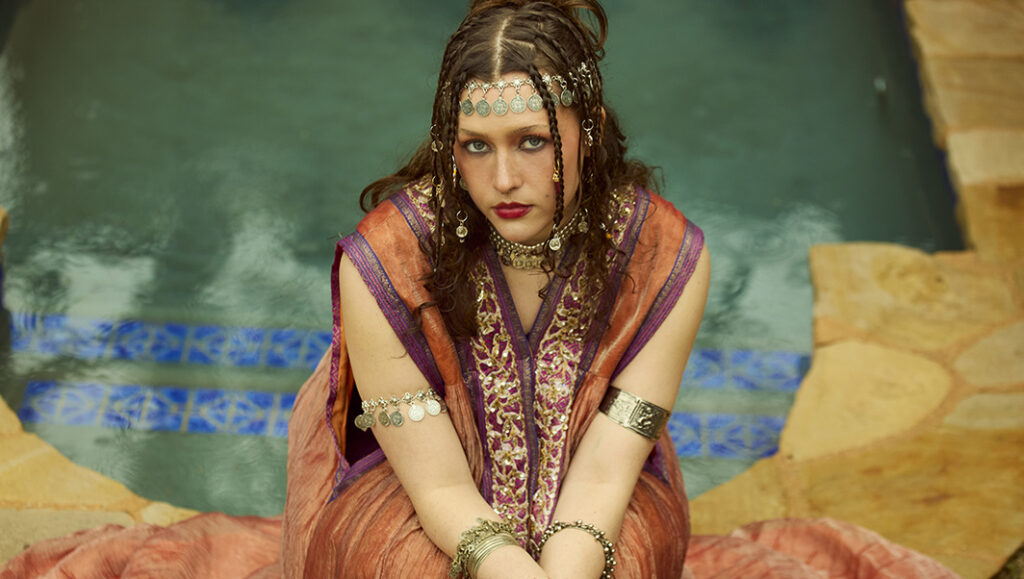
Karin Ann’s artistry thrives at the intersection of sound, emotion, and imagination. Her music has an intimacy that draws listeners into the stories she tells, pairing introspective lyrics with a haunting quality that feels both personal and cinematic. In Orion, she brings that same sensitivity to two interconnected creative roles, making her feature film acting debut while crafting an evocative soundscape that gives the story another dimension.
A psychological sci-fi thriller starring Andrew McCarthy, Drew Van Acker, and Debby Ryan, Orion follows an astronaut who loses his memory after a crash landing kills the rest of his crew. When a NASA interrogator attempts to reconstruct what happened, the investigation gives way to a more complicated search for the truth. Alongside her portrayal of Morgan, Karin Ann contributes four original songs whose intimate songwriting and atmospheric production heighten the film’s emotional pull.
Pop Culturalist caught up with Karin Ann to discuss the creative exchange between acting and songwriting, how immersing herself in Morgan’s world inspired music she hadn’t planned to write until after filming, and the care behind translating acoustic beginnings into a cinematic soundscape. She also opened up about learning through observation, letting go of self-imposed limitations, and following the instincts that connect every facet of her artistry.
PC: The creative team specifically chose you to craft the film’s soundscape. How did that trust give you the freedom to push yourself creatively, and how did you draw on your own artistic vision and experiences to serve the larger story?
Karin: I’d say it was challenging because, really early on, I said, “If you have a specific sound in mind that’s really poppy or very electronic or something, you should go with a different artist because I know what I like, and I’m going to do what I like, what represents me, and what feels authentic to me.”
But from the beginning, they were very much like, “No, we love what you’re doing.” And then every time I would send an idea over, I’d just get back, “We love it. This is great.” I’d never get any sort of direction, which made it quite hard because I’m quite an overthinker. So I’d just be like, “Oh my God, what if they hate it and they’re just too scared to tell me? Or what if they were picturing something else?”
I asked if there were any soundtrack songs that felt in the realm of the vibe they were going for. They gave me one song, and I think it was a song by Robert Pattinson called “Willow” [from the High Life soundtrack]. They were like, “We love the sound of this song, but we want you to have complete creative freedom.” So it was challenging in that regard, but the reassurance also made me feel really safe exploring what I wanted to explore.
I think I was able to naturally weave some of the more atmospheric sci-fi elements into the folkier sound that I have. I made a playlist for myself for inspiration, just kind of what I thought worked energetically. I never felt like there was any pressure on me to go in a direction I didn’t want to go. In fact, it was the opposite! So even though it was challenging in that regard, it also allowed me to create what I did and what I think fits the movie really, really well.
PC: You also have a role in the film. Can you talk about the creative process of bringing your different talents together and how your experience as an actor informed the music you created, and vice versa?
Karin: In my opinion, acting and songwriting are quite similar. You have to be able to access your emotions really easily for both. The only difference is that, in my songwriting, I mostly write from my own experience. There have been certain songs where I’ve written about somebody else’s experience. Obviously, when I was writing for Orion, I was writing about the movie.
When you’re acting, you’re bringing a character to life who doesn’t exist. It’s a fictitious person, and you have to make them real. You have to take them off the page and build them into this full being. They have a rich life and experiences. They live in the world, whether it’s our world or a fictional world. They go through things, feel things, and live the human experience. You can only really do that if you’re in touch with your feelings and you’re aware of and have empathy for other people.
You have to understand how certain things affect people and how different situations might result in different outcomes for a person. You have to make sure that you understand why the character you’re playing is the way they are, why they react the way they do, and why they say things the way they say them. When they say things, do they mean them? Are they lying? If they’re lying, why are they lying?
I’ve always loved both, and I’ve always wanted to do both, so it was really, really cool that I got to not only soundtrack the movie but also act in it. I do think that, in a way, acting in the movie helped me write the music for it because it really helped me immerse myself fully and experience the world from an inside point of view.
PC: You’re such a student of your craft, and even on days when you weren’t filming, you spent time on set. What did you learn from watching your co-stars that you’ll carry into future projects?
Karin: It’s definitely helpful to watch other people and learn from them, kind of the same way it is with writing music. My writing improved a lot when I started, I don’t want to say studying other people’s music, but understanding other people’s writing more. It took me into realms and genres that I never thought I’d be able to explore because I’d put my own limitations on myself. You know, whether it was, “English isn’t my first language, so I’m never going to be able to tell stories the way I’d love to,” or “How am I supposed to write a song in that genre?” Whatever it may be. Once I let go of those limitations and just started listening and truly absorbing what other people were doing, it became so much more natural for me to move into certain spaces or say things in certain ways. For example, with songwriting, listening to other people’s music and reading their stories and lyrics really helps you with vocabulary as a non-native English speaker.
In acting, it’s always really helpful to study people. It’s why I really love going to live theater, not only for the experience but also to understand why certain actors are making certain choices for certain characters. It comes to a point where you can only learn more through practice, which is always the most difficult part. But I also always enjoy observing and trying to understand people more, trying to understand characters more, and trying to understand people’s minds more.
PC: There’s such a beautiful juxtaposition in the soundtrack. It feels introspective yet cinematic, and I know you created an Orion-inspired playlist to get those creative juices flowing. Do you remember what was on it, and how did you balance that sense of intimacy with the larger cinematic moments?
Karin: Gosh, I mean, I made that playlist over two years ago at this point, so I’m not sure if I’ll be able to remember everything. There was a lot of Mazzy Star. There was a lot of Agnes Obel. There were some songs from the Twilight soundtrack and The Hunger Games soundtracks. There was the song that production recommended, “Willow” by Robert Pattinson. I also had my own song on it called “put me back together.” There was also this song called “I Am the Antichrist to You.” I’m not sure who it’s by, but I’m pretty sure it was in a show.
But in terms of the other part of the question, I never made conscious decisions about what I thought would be best. I think I just followed my intuition and naturally came up with things. I’ve often been told that my writing is very intimate, so that’s just how I approach writing in general.
I tried to make it more cinematic to fit the genre of the movie, not through the writing itself but through the production. You know, incorporating certain instruments and figuring out what kinds of sounds would work best for a song to make it a little bit more spacey. I approached the production based on a lot of the visuals that I knew were in the movie and what I imagined. I often describe sounds through colors or things you can see or touch. Often, I’m like, “I need a sound that sounds like a shooting star,” or “I need a sound that sounds like a stream in a forest, but it’s a guitar,” or “I need a sound that sounds like a very specific shade of blue,” you know?
Obviously, when we wrapped filming, I didn’t see the editing or the special effects, so there were some things left to the imagination. I do know that I very specifically wanted the whistling sound in “born to be,” and that was something that was really missing for me, but I can’t whistle! It was a really hard process to find somebody to do it because I didn’t want it to be perfect. It needed to be a little bit fucked up and sound very raw. That’s something that I specifically wanted for the song because it just made sense. That’s how I approach my music in general: it needs to make sense. And until it does, I’m just trying different things and different ideas.
PC: When done right, music amplifies what we’re seeing on screen, and there’s such an introspective, haunting quality to your music that really heightens that experience. Knowing you wrote the songs before filming, what was it like seeing how they came together with the performances and visuals in the finished film?
Karin: It really helped that I was acting in the movie, so I was able to immerse myself in the world quite heavily. I wrote the songs when I was prepping for the shoot, so I had the script and was analyzing it for my character, the different relationships between the characters, why they’re doing the things they’re doing, and how the world they’re in works.
When I was immersing myself in that world and bringing Morgan to life, there were just certain things that spoke to me. All the songs came really naturally to me. I told the people in production in advance, “Don’t expect any songs from me until I see at least the first cut of the movie.” So I really did not plan on writing them in advance. That’s just how it happened naturally.
For example, “i can’t trust your eyes” is inspired by a very specific scene in the movie. When I read it in the script, I was like, “I know exactly what’s happening here,” and it felt really inspiring to me. So I wrote it, and then, on set, I was actually able to see that scene being filmed, and it was very much what I’d pictured it to be. It just all came very naturally, and if it made sense, it made sense.
PC: You’d written all the songs two weeks before filming. Did any of them take on a new life or meaning once you started shooting?
Karin: I don’t think they took on a new meaning, but what I wrote before filming was very acoustic, except for one song that was an old demo of mine. I really liked the melody, and I just changed the lyrics. Everything else was just me and my guitar, and that was all I had.
We were working on the production after shooting had wrapped. Being on set and seeing how certain scenes were framed, how certain props were used and what they looked like, the costuming, the set design, all of that informed the production. So, in that way, the production breathed new life into the songs. That’s what I wanted anyway. I never planned on writing the songs before seeing the first cut of the movie, so the fact that that happened was crazy and unexpected. I was planning on doing the production afterward because I needed to see, at least partially, what the visuals looked like. But I wouldn’t say they fully took on a new meaning because I was already taking that from the source material.
PC: If you had to pick one song from Orion that best captures who you are as an artist, which would it be and why?
Karin: I don’t think I can pick! It’s like asking somebody to pick between their children. I think the one that describes me as an artist the least is “it’s too late to turn back now,” and that’s just because it was originally a demo of something else that I made six or seven years ago, a very long time ago, so it feels like something I’ve outgrown. Obviously, we revamped it. We changed the lyrics and revamped the production. The only reason I used it is because I like the song, but I think it’s the least like what I do and who I am now.
But I really love all three of the others, and I think it also depends on when you ask me. I think there are different points in the day when I would give you a different answer. Even now, I was thinking maybe “until i am gone,” but then there’s “born to be,” and then there’s “i can’t trust your eyes,” and each song just has something different and special about it. I put a little bit of myself into everything I make and everything I do, so it’s really an impossible question to answer.
PC: Outside of Orion, what’s next for you?
Karin: You know, there are always things that I’m working on. There are always projects that I have in the works. I’m definitely working on new music and something else that’s new that I can’t talk about yet. It involves music, but not necessarily my personal music. I also shot another movie. I’m not sure when it’s coming out, but it’s called Rough Draft, and I shot that last year! People just kind of have to wait and see because I don’t like talking about things until they’re done and out there.
To keep up with Karin, follow her on Instagram. Orion is out in select theaters now and on digital on November 3rd.
Photo Credit: Yasmine Kateb

Discussion about this post